
Introduction
Calculating an average is simple when every number has the same level of importance. However, in many real-life situations, some values matter more than others. A final exam may count more than homework assignments, a larger investment may have a greater impact on portfolio returns, or certain products may contribute more to a company’s revenue. In these cases, using a standard average can produce misleading results. That’s where a weighted average calculator becomes useful.
A weighted average calculator helps users determine an accurate average by considering the weight or percentage assigned to each value. Instead of spending time performing manual calculations, this tool provides fast and precise results. Whether you’re a student, teacher, investor, business owner, or simply someone working with numbers, a weighted average calculator makes calculations easier and helps you make better-informed decisions.
What Is This Tool?
A weighted average calculator is an online tool that calculates an average while taking into account the importance of each value.
Unlike a regular average calculator, which gives equal importance to every number, a weighted average calculator assigns different weights to values based on their significance.
For example, imagine a class grading system:
- Homework – 20%
- Quizzes – 15%
- Midterm Exam – 25%
- Final Exam – 40%
A student who scores highly on homework but poorly on the final exam may still receive a lower overall grade because the final exam carries more weight.
The calculator automatically multiplies each score by its assigned percentage and combines the results to provide an accurate overall average.
Understanding Weighted Averages
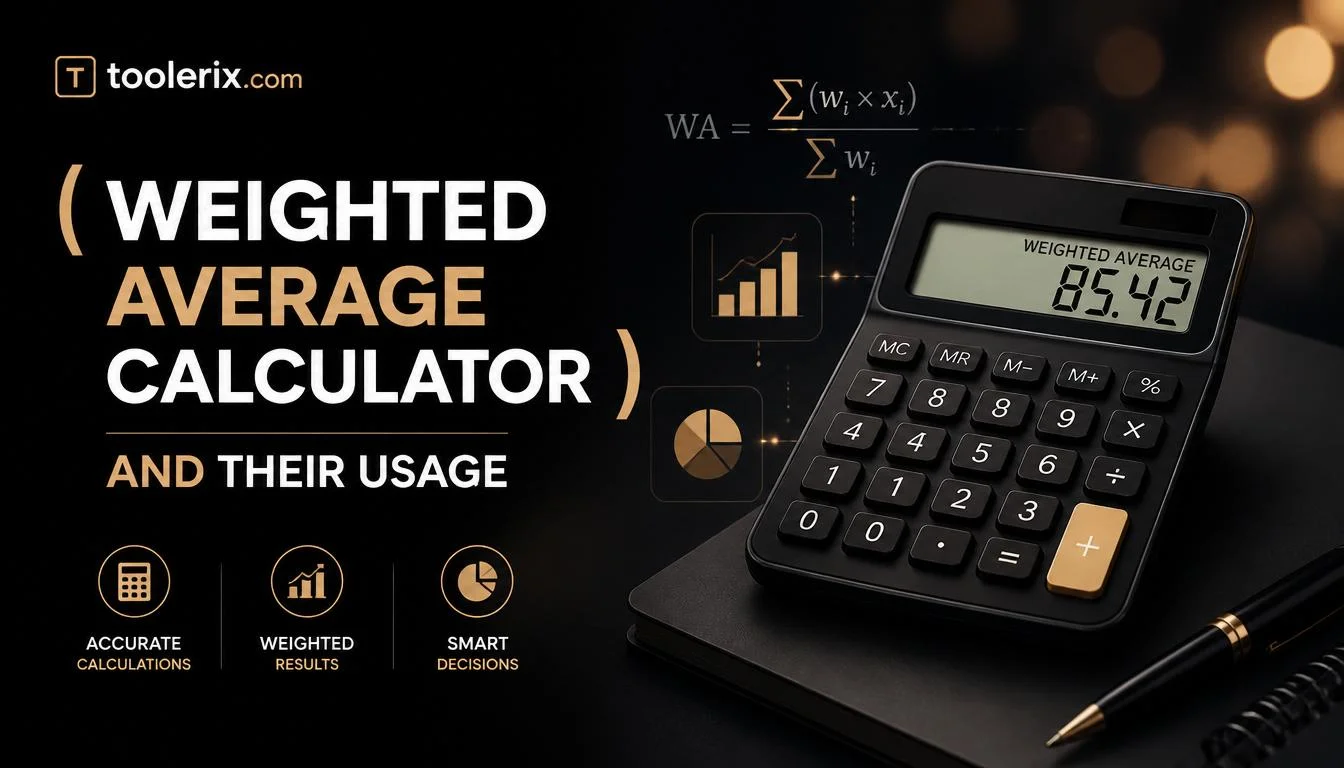
A weighted average follows this basic formula:
Weighted Average = Sum of (Value × Weight) ÷ Sum of Weights
Although the formula itself is straightforward, calculating multiple categories manually can be tedious.
A weighted average calculator simplifies the process by doing all the calculations instantly.
Where Weighted Averages Are Used
Weighted averages are commonly used in many areas, including:
- Education
- Investing
- Business management
- Research studies
- Inventory valuation
- Customer satisfaction analysis
- Performance reviews
Because weighted averages provide a more realistic representation of data, they are widely used for decision-making.
How to Use This Tool
Using a weighted average calculator is simple and requires only a few steps.
Step 1: Gather Your Values
Start by collecting the numbers you want to average.
Examples include:
- Assignment grades
- Exam scores
- Investment returns
- Product sales
- Survey results
Sample values:
Homework = 94
Quiz = 88
Midterm = 85
Final Exam = 91
Step 2: Determine the Weight for Each Value
Next, identify the percentage or importance assigned to each category.
Example:
Homework = 20%
Quiz = 10%
Midterm = 30%
Final Exam = 40%
Ensure all percentages add up to 100%.
Step 3: Enter the Information
Input the values and their weights into the calculator.
Example:
| Category | Score | Weight |
|---|---|---|
| Homework | 94 | 20% |
| Quiz | 88 | 10% |
| Midterm | 85 | 30% |
| Final Exam | 91 | 40% |
Step 4: Click Calculate
Press the calculate button.
The calculator immediately processes the information.
Step 5: Review the Results
The tool displays your weighted average instantly.
Depending on the calculator, additional details may include:
- Percentage grades
- Letter grades
- GPA estimates
- Future target calculations
Tips for Accurate Results
Double-Check Percentages
Incorrect weights can lead to inaccurate averages.
Always verify that the total equals 100%.
Use Updated Scores
Current grades or recent data provide the most reliable outcomes.
Estimate Carefully
If some values are not available yet, use realistic estimates.
Example
Let’s examine how a weighted average calculator works in a practical situation.
Example 1: College Student Grade Calculation
Emma is enrolled in a psychology course.
The grading structure is:
Assignments = 20%
Participation = 10%
Midterm = 30%
Final Exam = 40%
Her grades are:
Assignments = 93%
Participation = 95%
Midterm = 84%
Expected Final Exam Score = 89%
Step-by-Step Calculation
Assignments:
93 × 0.20 = 18.60
Participation:
95 × 0.10 = 9.50
Midterm:
84 × 0.30 = 25.20
Final Exam:
89 × 0.40 = 35.60
Total:
18.60 + 9.50 + 25.20 + 35.60
Weighted Average:
88.90%
Emma’s expected final course grade is approximately 89%.
Example 2: Investment Portfolio Performance
An investor owns three assets.
Asset A:
Return = 12%
Weight = 50%
Asset B:
Return = 8%
Weight = 30%
Asset C:
Return = 6%
Weight = 20%
Calculations:
12 × 0.50 = 6.0
8 × 0.30 = 2.4
6 × 0.20 = 1.2
Total Return:
9.6%
The weighted average return of the portfolio is 9.6%.
This provides a more accurate picture than simply averaging the returns.
Benefits of Using This Tool
A weighted average calculator offers many practical advantages.
Saves Time
Calculating weighted averages manually can take several minutes.
The calculator produces results instantly.
Improves Accuracy
Automation reduces the risk of mathematical mistakes.
Easy to Use
No advanced math knowledge is needed.
Anyone can use the calculator.
Helps Set Goals
Students can estimate the grades needed to achieve a target score.
Investors can analyze expected returns.
Supports Better Decisions
Weighted averages provide meaningful insights.
Users can make more informed choices.
Useful Across Different Fields
The calculator works well for:
- Education
- Finance
- Business
- Research
- Personal planning
Accessible Anywhere
Online calculators are available on:
- Smartphones
- Tablets
- Laptops
- Desktop computers
Reduces Stress
Knowing exact results removes uncertainty.
Users gain confidence in their planning.
Who Can Use This Tool?
A weighted average calculator is useful for almost everyone.
Students
Students often use weighted averages to track academic performance and estimate final grades.
Teachers
Teachers can quickly verify grading calculations.
College Applicants
Applicants can monitor GPA goals and scholarship requirements.
Investors
Weighted averages help evaluate investment portfolios.
Business Owners
Companies use weighted averages for sales analysis and financial planning.
Financial Professionals
Analysts frequently calculate weighted returns and market indexes.
Researchers
Researchers apply weighted averages in surveys and data studies.
Parents
Parents can help children monitor school progress.
Anyone Working With Numbers
Anyone comparing multiple values with different levels of importance can benefit from this tool.
Frequently Asked Questions
What is the difference between a weighted average and a regular average?
A regular average gives equal importance to all values.
A weighted average assigns different levels of importance based on percentages or weights.
Is a weighted average calculator accurate?
Yes.
When correct values and weights are entered, the calculator provides highly accurate results.
Do weights always need to equal 100%?
In most educational and business situations, yes.
The total weight should equal 100% for accurate calculations.
Can businesses use weighted average calculators?
Absolutely.
Businesses commonly use weighted averages for:
- Revenue analysis
- Product performance
- Customer feedback
- Financial forecasting
- Inventory management
Conclusion
A weighted average calculator is a valuable tool for anyone who needs to calculate averages that reflect the true importance of different values. Instead of relying on simple averages that may overlook key factors, this calculator provides precise and meaningful results in seconds.
Whether you’re a student trying to predict final grades, an investor evaluating portfolio performance, a business owner analyzing sales data, or a researcher working with survey responses, a weighted average calculator saves time, improves accuracy, and supports smarter decision-making. By using this tool regularly, you can better understand your data, plan effectively, and make confident choices based on reliable calculations.
Try It Yourself
Want to calculate this instantly?
Try our free [Calorie Calculator] now!
DISCOVER MORE ARTICLES
Weighted Calculator: Find Accurate Weighted Averages 2026
Weighted Grade Calculator: Find Your Final Grade 2026
What Age Am I? Find Your Exact Age Instantly 2026

Shahzad is the Founder & CEO of Toolerix, a modern online platform built to make everyday tools, calculators, converters, and utilities simple, fast, and accessible.
With a focus on practical digital solutions and user-friendly experiences, Shahzad is building Toolerix to help people get accurate results without unnecessary complexity.
Founder & CEO — Toolerix
Smart Tools. Faster Results.